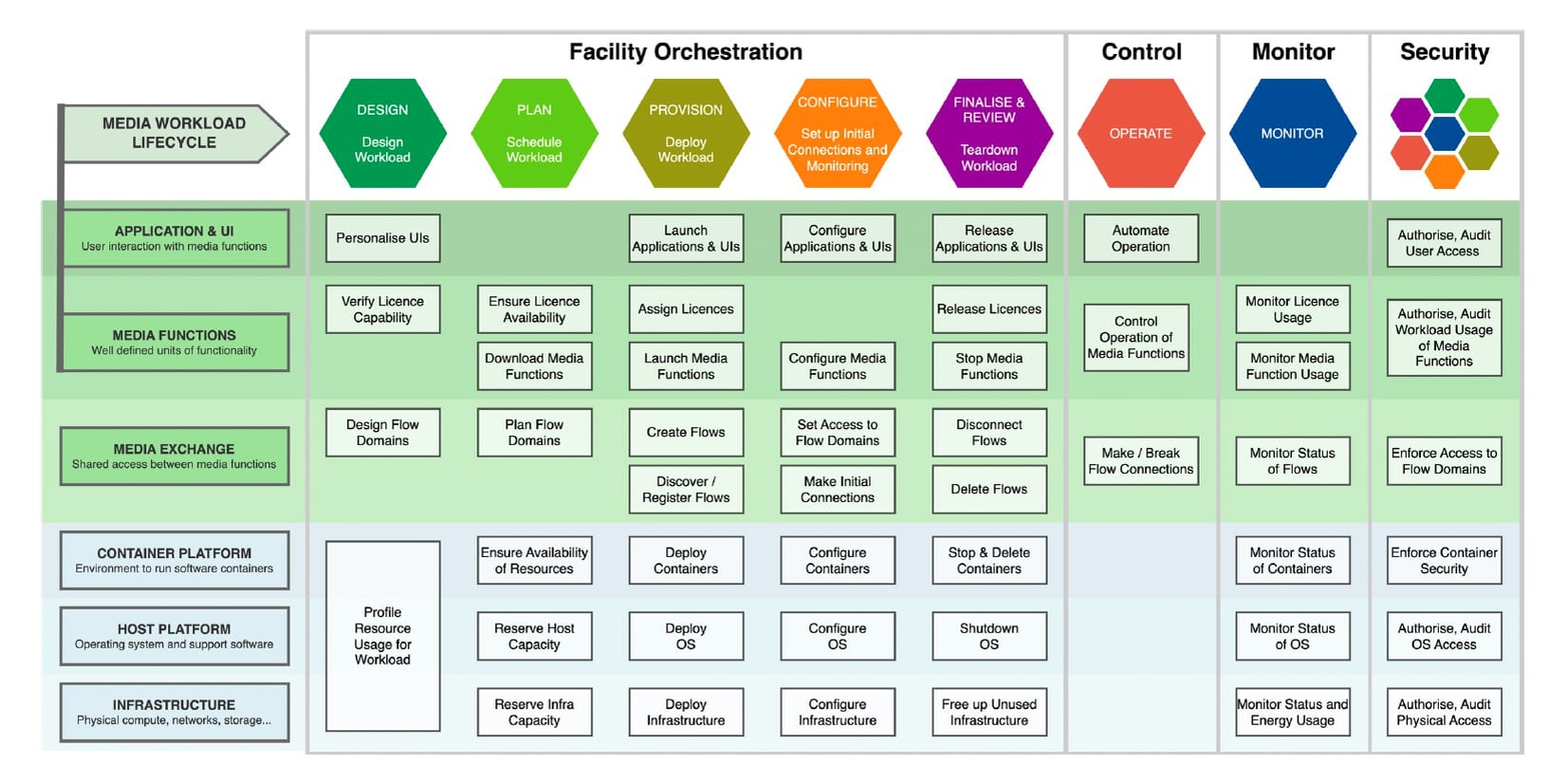

I recently had the privilege of moderating a NABA-sponsored panel on the Dynamic Media Facility (DMF) initiative — what it is, why it matters, and what has to happen to make it real.
There’s no shortage of talk about DMF right now, but what made this discussion different was the range of expertise around the table.
Joining me on the panel were Willem Vermost from the EBU, who serves as program manager of the cross-functional Working Group shaping the DMF vision; John Mailhot from Imagine, who chaired the drafting of ST 2110; Andy Rayner from Appear, who leads the JT-DMF timing work; and Naveed Aslam from CBS Paramount, bringing the broadcaster’s perspective.
The conversation covered a lot of ground — here are some of the highlights.
CTO,
Appear

SVP, Product Management,
Imagine Communications
Senior VP, Production Technology & Engineering,
CBS / Paramount
Senior Media Technology Architect,
European Broadcasting Union (EBU)
We’ve made the move to IP. We know ST 2110 works. So why does the full payoff still feel out of reach? Naveed Aslam put his finger on it immediately.
“We’ve taken an SDI plant and replaced it with IP,” he said, “but we haven’t necessarily changed our workflows or our methodology and approach. The DMF initiative is truly the key to start unlocking the practical and technological benefits that we can derive from an IP infrastructure.”
That’s the gap DMF is designed to close — not the transport layer, which 2110 handles well, but the software-defined framework above it that lets you design, provision and operate a truly dynamic facility.
John Maihot, whose work with ST 2110 spans a decade, explained, “2110 came at a time when the industry was ready for what was next, and it inherited all the wishes of all the things that IP could become. But many of those wishes weren’t things that transport could fill.
“While 2110 does a great job of utilizing an IT infrastructure to replace SDI, it doesn’t solve the upper layer problem,” he added. “It’s really the goal of the DMF to organize those upper layers so that you can actually have a dynamic facility.”
Willem Vermost framed the business case with a statistic that should make every CFO in broadcasting sit up. Research from Skyline Communications suggests that across a typical broadcast facility, only around 10% of equipment is actually in use at any given time.
“We always design for peak,” he said. “When there’s elections, when there’s Olympics, we make sure we get everything for peak in our facility. But that’s not efficient. How can we share those very expensive resources amongst more productions? That’s really what we’re trying to aim for.”
The DMF vision is fundamentally about fixing that — creating a software-defined environment where resources can be shared, reallocated and spun up or down on demand, rather than sitting idle between major productions.
For Naveed, the day-to-day operational appeal is equally concrete, saying, “What we see DMF enabling is being able to group and ungroup those resources ad hoc, depending on what the day’s requirement is — allowing us to maximize the availability of the devices and the infrastructure that we have.”
“The DMF initiative is truly the key to start unlocking the practical and technological benefits that we can derive from an IP infrastructure.”
Naveed Aslam, CBS Paramount
Moving to a true DMF isn’t just a technology decision — it requires a significant shift in how facilities are planned, operated and staffed.
Willem was candid about the complexity ahead. “Suddenly, we need to plan a person, and that person is going to be in a room, and that room could be an edit room — and with a flick of a button, it could be a video gallery drawing on licenses, CPUs, GPUs. That’s a huge change compared to what we’re doing today.”
John added a broader industry dimension: the largest broadcasters have engineering teams that can navigate the complexity of a Kubernetes cluster and an RDMA network. But it’s a big world.
“These things need to become less complicated and less science-y,” he said, “in order to move into the broader deployment of the world.”
For Naveed, the operational priority is self-sufficiency — the ability to run and adapt the system day to day without depending on vendor support for every configuration change.
“We definitely want to be more in control of our destiny,” he said. “We want to be partnered with our key vendors and manufacturers, and know that we can turn to you for the core of the system. But on the day-to-day level, we want and need to be self-sufficient. If we can do this in parallel with our manufacturer partners, I think together we can accelerate the whole time to deployment — which is going to be a big payoff.”
“These things need to become less complicated and less science-y in order to move into the broader deployment of the world.”
John Mailhot, Imagine Communications
The short answer from the panel was yes — but with an important qualifier. Andy Rayner was direct: “MXL is a really vital component, but it is only one component of a whole suite of capabilities we need to realize this vision.”
MXL is an open source project, now in active development within the Linux Foundation, that enables applications running on a compute cluster to share media — pixels, audio samples, ancillary data — through shared memory, without making unnecessary copies. It is, as John put it, “the sort of thing where everybody agrees that we need one, but nobody really wants to write it by themselves.”
He added, “It’s a great way for the industry to work together for the common good to create a unifying layer underneath all of these applications where each vendor adds value.”
“MXL is a really vital component, but it is only one component of a whole suite of capabilities we need to realize this vision.”
Andy Rayner, Appear
The panel closed on perhaps its most important question, and the responses were candid.
CBS Paramount is planning a large-scale refresh of its New York broadcast center, and DMF is central to its future state. Naveed said,”Probably the biggest fear is that we’re wanting to be part of something that isn’t quite fully defined yet. But the risk of building a facility that would come online two years from now and be essentially on the same platforms as we have today — I think that’s a bigger risk for us to take as a business.”
John’s view was similar in conclusion but rooted in a longer view of how technology transitions play out. “The early adopters can do these very complicated things — but these things need to become less complicated to move into broader deployment.”
Andy agreed, adding, “The risk is insufficient completion of the toolkit. We need all of the components, otherwise every operator wanting to use this will have to deploy a massive DevOps team just to make it work. We don’t want that.”
Willem offered a reminder that the initiative’s success depends on the industry following through on all of it — not just MXL, but the full stack of capabilities above it. He said, “We just need to make sure that we finish the job. Otherwise, we don’t reap all the benefits. The potential threat is that at some point we might think we’re done, and we’re not yet there.”
“We just need to make sure that we finish the job. Otherwise, we don’t reap all the benefits.“
Willem Vermost, EBU
The Dynamic Media Facility is being defined right now — that’s precisely the right moment to be part of the conversation. The full panel session is available to watch, and it’s well worth the hour for anyone thinking about the future of their production infrastructure.