Recorded at SVG College Summit 2025
Smarter live production, connected campus wide.
In this session, Matt Alvarado from the University of Texas joins Jimbo Haneklau of Imagine Communications to explore the university’s transition from outsourced production to a fully in-house operation.
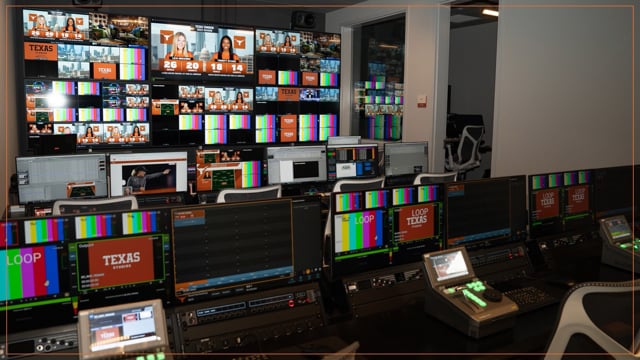
Over the past year, the University of Texas has built a centralized, ST 2110-based facility with five IP-connected control rooms serving eight venues across multiple campuses. The result is a highly flexible infrastructure that simplifies video signal management, maximizes I/O, and allows any control room to support any event.
They discuss key considerations in making the shift, the advantages of IP-based workflows, and how campus-wide interconnectivity is unlocking greater efficiency, scalability, and creative control.
What you’ll learn
- Why the University of Texas brought live production fully in-house
- How they built a centralized, ST 2110-based control room infrastructure
- How IP interconnectivity supports multi-campus production
- How ST 2110 maximizes I/O and simplifies routing
Whether you’re a broadcast engineer, systems integrator, or technical lead, this is your playbook for building flexible, campus-wide production with IP and ST 2110.